

Welcome back to another weekly portfolio update.
In this update, we’ll be looking at how the portfolio performed between 3 October and 10 October, what drove the gains and losses this week, what I’ve learnt, and the ETF I’ll be researching next.
Hopefully you’ve had a chance to read my last post looking at QQIA. If you haven’t already, do check it out. It’s another income-generating ETF that I’ve been researching recently.
But for now, let’s get into this week’s update.
Portfolio Snapshot
This week was actually a slight step backwards for the portfolio.
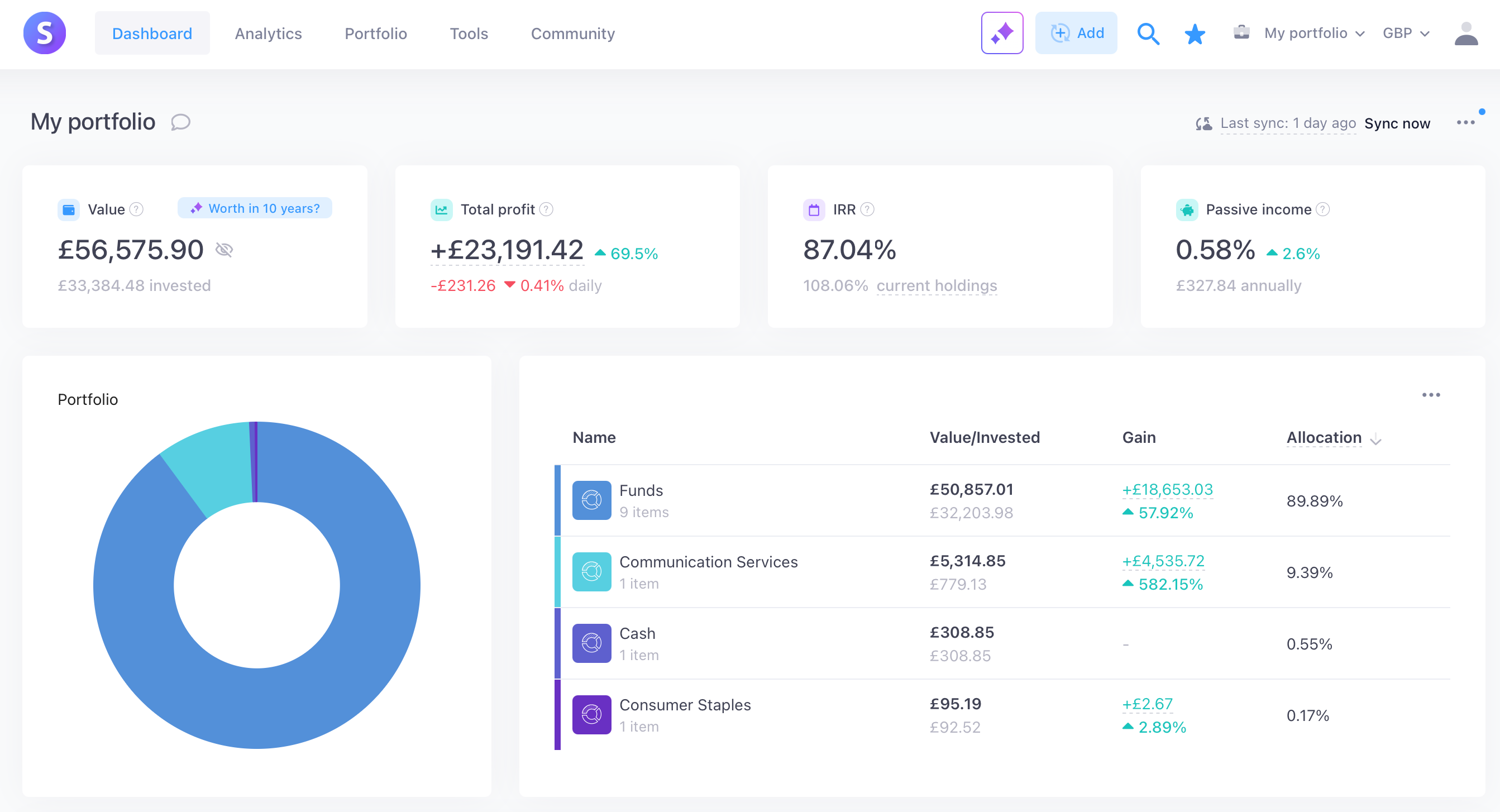
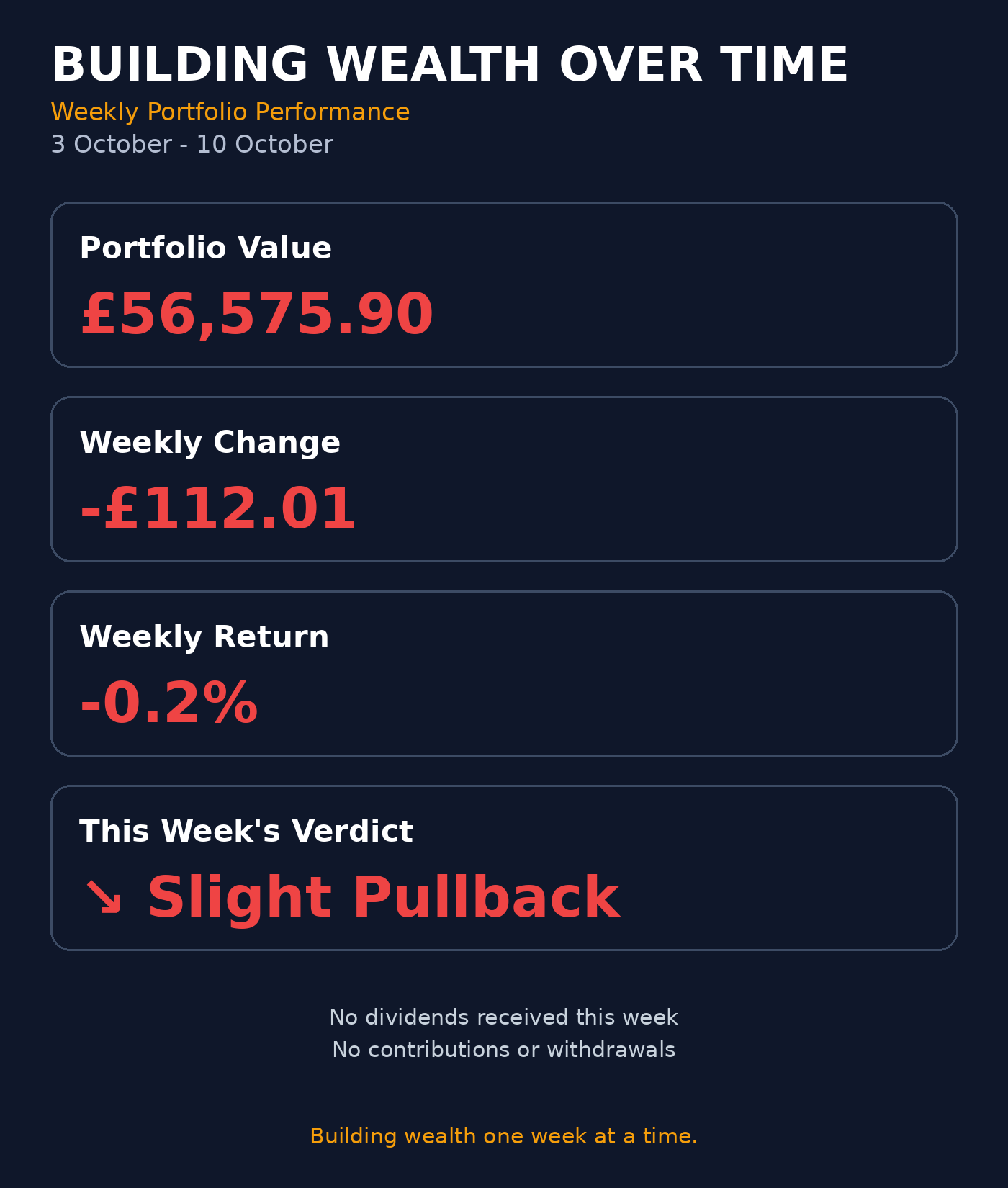
The opening balance last week was £56,687.91, while the closing balance on 10 October was £56,575.90.
That means the portfolio fell by £112.01, which works out at around 0.2%.
No dividends were received this week, and there were no contributions or withdrawals.
That said, I did have some cash sitting in the account which I used to top up a few ETF positions.
Portfolio Performance
Portfolio Value: £56,575.90
Weekly Change: -£112.01
Weekly Return: -0.2%
Dividends Received: £0
What Caused The Drop?
Looking across the portfolio, there was really one clear culprit this week.
My semiconductor ETF, SMGB, fell by 4.94%, which represented a loss of £172.48.
If you’ve been following the market recently, you’ll probably be able to guess what sector was behind that.
AI.
That weakness also filtered through to my Invesco Technology ETF (XLKQ), which fell 0.52%, representing a decline of £79.20.
To be honest, that wasn’t actually too bad.
I think the ETF was probably cushioned by the fact it isn’t purely reliant on AI stocks. You’ve got plenty of other technology companies in there helping balance things out.
Other fallers included:
Meta: -£33.63 (-1.22%)
First Trust Smart Grid Infrastructure ETF (GRID): -£23.84 (-1.45%)
What Helped Offset The Losses?
While semiconductors had a tough week, there were still some strong performers elsewhere in the portfolio.
Amazon was the standout, rising by £167.56.
My Vanguard S&P 500 ETF (VUSA) also had a really good week, increasing by £149.26.
This is one of the reasons I like broad market ETFs.
Even when one area of the market is struggling, you’ve got hundreds of other companies helping to soften the blow.
Other positive performers included:
Alphabet: +£126.97
Microsoft: +£40.59
Netflix: +£24.84
When you look at those gains, it probably explains why VUSA held up so well despite some of the weakness elsewhere.
What Happened In The News?
As mentioned above, the main weakness came from AI and semiconductor stocks.
Part of this appears to have been linked to reports around OpenAI’s revenue figures.
There were reports suggesting OpenAI’s annualised revenue was lower than some previous estimates, which caused concerns across parts of the AI sector.
Naturally, when something like that happens, investor confidence takes a hit and markets don’t always wait around for all the facts before reacting.
However, after reading more into the story, there seems to be a lot more nuance than the headlines initially suggested.
A number of reports indicated that part of the discrepancy was due to differences in how revenue was being calculated, particularly when sales through cloud providers were taken into account.
There are also reports suggesting revenue growth remains strong and could continue to increase significantly over the next year.
For me, that changes the way I look at the situation.
I’m not seeing this as a reason to panic.
I’m certainly not rushing out to sell my semiconductor ETF.
At the moment, it feels more like short-term market noise than a genuine threat to the long-term AI story.
So my plan remains exactly the same.
Keep investing.
Keep holding.
Keep focusing on the long term.
What I Learnt This Week
If you’ve read my last couple of posts, you’ll probably notice I keep coming back to income-generating ETFs.
The more I research them, the more interested I’m becoming.
As I mentioned in my QQIA post, I really like the idea of receiving income even during periods where the market isn’t doing much.
There’s something quite reassuring about that.
If the market slows down, you’re still receiving cash through distributions.
I’ve already got JEQP, which has been doing pretty well from a dividend perspective, and I’m starting to think about increasing my exposure to these types of ETFs over time.
What’s interesting is that writing these articles is actually helping shape my own investing decisions.
Every week I’m reading more.
Every week I’m researching more.
And every week I’m discovering investment approaches I previously hadn’t considered.
I’ve always been very focused on growth.
Now I’m starting to think more about balancing growth with income.
That’s why QQIA caught my attention.
I like the fact that you still have the opportunity to participate in market growth, while also generating regular income through the covered call strategy.
So I think you’ll probably see me continue exploring this area over the next few months.
ETF Spotlight: GPIQ
The ETF I’ll be researching this week is GPIQ, the Goldman Sachs Nasdaq 100 Premium Income ETF.
Yes, another income ETF!
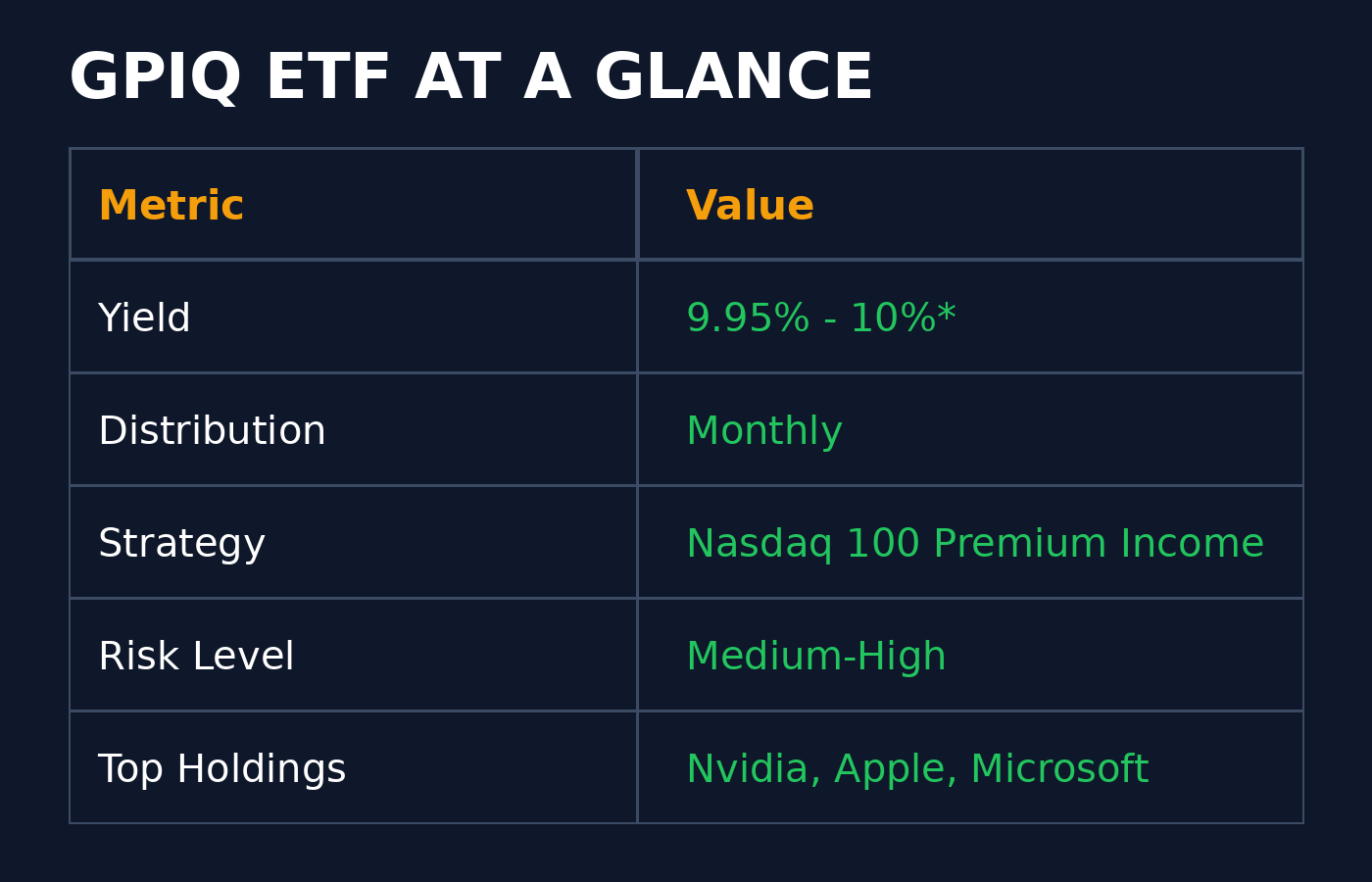
Looking at the top holdings, you’ve got many of the companies you’d expect:
Nvidia
Apple
Microsoft
MicroStrategy
AMD
Amazon
Alphabet
Meta
Tesla
The top ten holdings account for around 57.91% of total assets.
The portfolio remains heavily focused on technology, with communication services being the next largest sector allocation.
What really caught my attention wasn’t the standard yield.
It was the monthly distributions.
Recent payouts have been running at around 9.95% to 10%, which immediately puts it on my radar.
That’s exactly what attracted me to ETFs like JEQP and QQIA as well.
The idea of receiving meaningful monthly income while maintaining exposure to large technology companies is definitely appealing.
Now, I haven’t done enough research yet to form a final opinion.
This is very much a first look.
But Goldman Sachs is obviously a huge name in the investment world, which naturally gives me some confidence in taking a closer look.
So over the next week I’ll be digging deeper into GPIQ and sharing my findings in a dedicated post.
Keep an eye out for that.
Final Thoughts

Overall, this wasn’t the strongest week for the portfolio, but equally it wasn’t a bad week either.
A decline of 0.2% isn’t something I’m particularly worried about.
If anything, it was another reminder that markets don’t move in straight lines.
Some weeks you’ll be up.
Some weeks you’ll be down.
The important thing is staying focused on the bigger picture.
For now, my plan remains exactly the same.
Keep investing.
Keep learning.
And keep building wealth over time.
Thanks for reading, and I’ll see you in next week’s update.
Jason
Building Wealth Over Time
P.S I track everything using Snowball, which enables me to monitor my portfolio performance and stay accountable to my goals.
👉 Track your own investing journey: [Snowball Analytics Link]
Affiliate disclosure: I may earn a commission if you sign up using the link above.